

I self-diagnose having shiny object syndrome (Don’t worry the above isn’t real…kinda dorky but I thought it was cute hehe). But it’s true. I latch onto something, become completely absorbed, and ride the wave until—bam—another shiny thing grabs my attention. And just like that, I’m off again. It sounds chaotic, doesn’t it? Maybe even like I’m avoiding commitment. But honestly? I’ve stopped trying to explain myself.
I’ll admit it: I’m not the person who will spend a lifetime perfecting one craft. I’ll never be the master of anything in the traditional sense. Instead, I’m a jack-of-many, a wanderer, a creator of eclectic little worlds that all sit in the corners of my life. I’ve dabbled in a lot—painting, writing this blog, photography, learning how to play piano, violin, dancing, stock trading, studying medicine, business ideas, and countless more.
Am I mediocre at a lot of things? Sure. But here’s what I know: I’m not mediocre at life.
The world most people live in is a world of boxes—careers, hobbies, roles, and identities neatly packaged and tightly defined. You’re told to pick a lane, settle in, and master it. The message is clear: do one thing and do it well. But what if that’s not what makes you happy? What if, despite being passionate and ambitious, you don’t have that one thing that makes you lose sleep at night? What if, for you, the thrill lies in jumping from one challenge to the next, rather than chasing a single, perfect passion? I’m the kind of person who works hard toward big goals, but what excites me isn’t just about perfecting one skill—it’s about starting new things, balancing different projects, and finding joy in the process. I don’t need to return to a single passion over and over; instead, I collect experiences—each one teaching me something valuable. There’s power in embracing the chaos, in seeing what sticks.
Now, let’s get one thing straight. I’m not saying I drop everything the moment something new catches my eye. It’s not about quitting—it’s about having a lot of interests that I get to revisit. Some things stay in the background, like an old friend you don’t talk to every day but still value deeply. I may not be the next great painter, but I’ll always love picking up my brushes when the mood strikes. And sure, my business ideas might not always take off, but they keep me excited and thinking outside the box.
Living this way means I’m constantly learning. Each new pursuit teaches me something valuable, even if it’s just a brief obsession. Let me tell you something: You don’t have to amazing at something to get something out of it. Some people think you need to master a skill in order for it to “count”. Not every project needs to be completed, and not every endeavor needs to have a final product. The value often lies in the process—the learning, the experimenting, the reflecting. For example, I spent months deep into stock trading, learning the ins and outs of the market. Did I make a fortune? No. In fact, I learned that I will never enjoy stock trading. I realized it’s not something that excites me, and I’d much rather outsource that work to someone who actually enjoys it and is good at it. But the experience still taught me something valuable: the importance of knowing where my strengths lie and when to delegate. It also helped me understand that it’s okay to admit when something isn’t for me, rather than forcing myself to stick with it. Then there’s photography. I wasn’t trying to become a photographer, but for a few weeks, I was obsessed with capturing the perfect shot. I learned about composition, lighting, and how to see beauty in the smallest details. I even started teaching myself how to edit pictures. It’s something I’ve carried with me, even though I no longer chase it daily, because it taught me how to be present and appreciate what’s in front of me. I also tried learning the piano. Was I ever going to be a concert pianist? Probably not. But the process of picking up something so new pushed me to be disciplined, to sit with discomfort, and to enjoy the progress even when it was slow. Plus, it’s a great party trick. It taught me that it’s okay to struggle, that small wins count, and that some skills are just fun to have in your back pocket—even if you never master them. Even writing this blog is part of my shiny object syndrome. It’s my way of getting better at writing and sharing my thoughts with anyone who finds them interesting (shoutout to anyone who loved thoughts of the day on thecinnamonstick :)) It’s just another project I dive into and revisit whenever the mood strikes.
The beauty of all this is that I get to live with variety. I get to explore a ton of different things and feel the high of starting something new. Is that “unfocused”? Maybe. But I’m starting to see that there’s power in being a little all over the place. I’m learning as I go, piecing together experiences that I wouldn’t have had if I’d locked myself into just one thing. Shiny object syndrome is not about the object at all. It’s about the spark. It’s about chasing that initial burst of excitement, that moment where your heart skips a beat and your mind races with ideas. It’s about capturing that magic before it slips away, and then being okay with the fact that once you’ve caught it, you may want to let it go. Because the next thing will come—and when it does, you’ll chase it too.
So, yeah, maybe I’ll never be the world’s greatest painter or the next big entrepreneur. Maybe I won’t finish several projects without getting distracted by the next shiny thing that pops up. But honestly? That’s fine. Because if being a “jack-of-all-trades” means I get to live a life full of random, delightful chaos, then I’m all in.
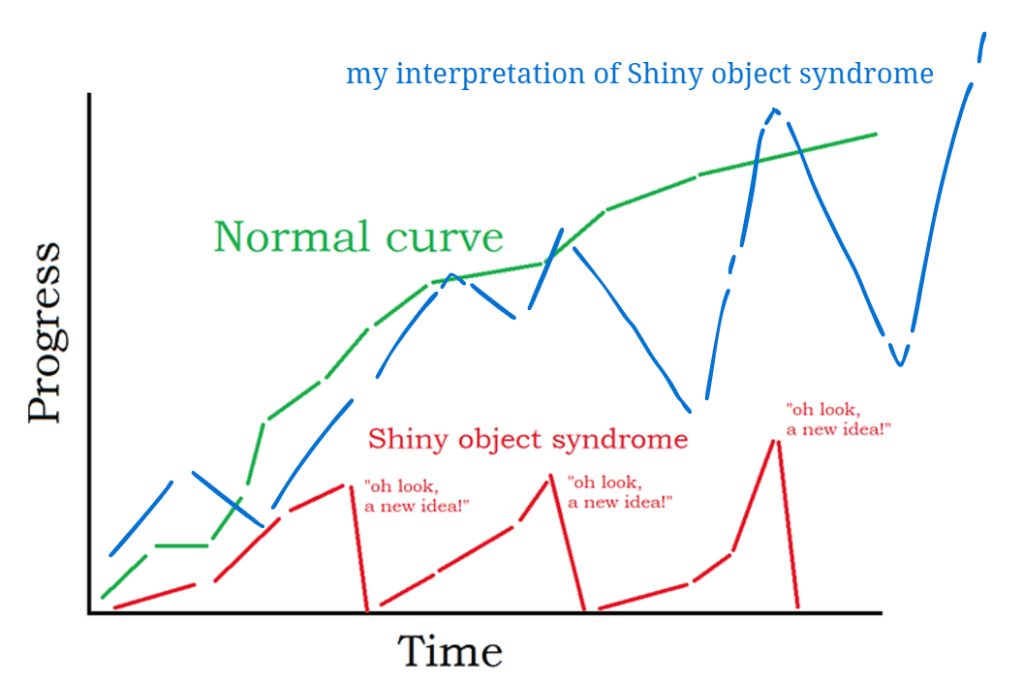
Here’s a Forbes article with a graph comparing a normal curve to that of shiny object syndrome on a time vs. progress graph (green and red lines, respectively). I took the liberty of adding my own interpretation of SOS (blue line), let me know your thoughts.

 the riva gallery